
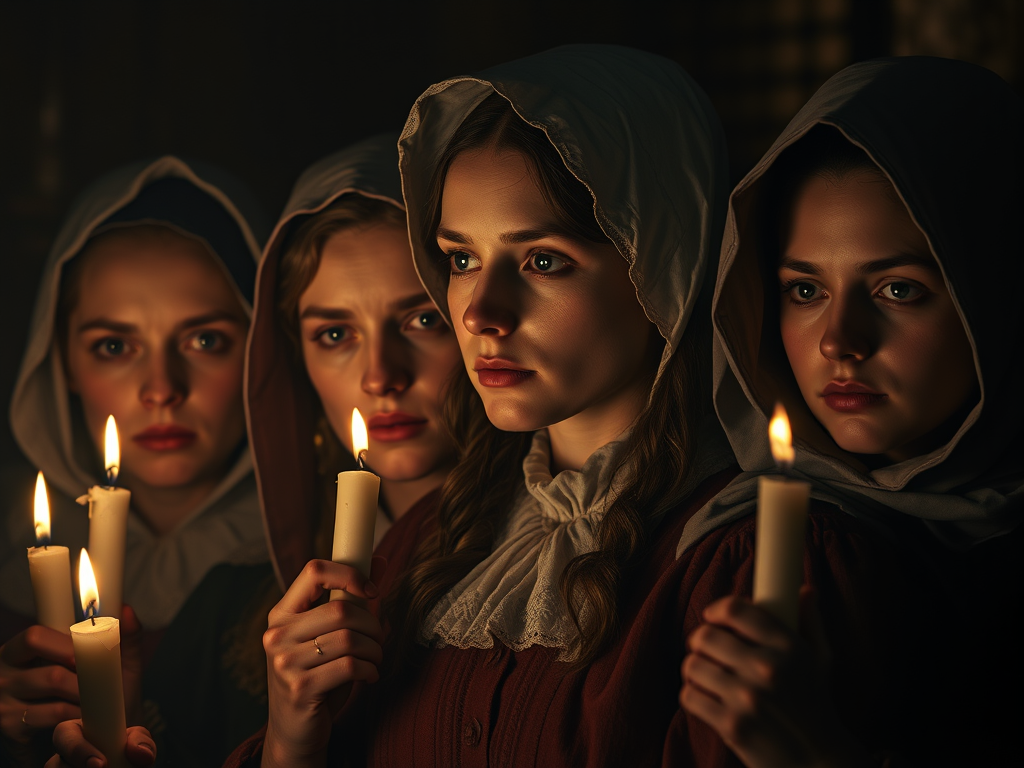
Witch of the Week: The Women of Salem, July 19, 1692
They weren’t witches. But they were women. And that was enough.
On July 19th, 1692, five women were sentenced to death during the height of the Salem Witch Trials.
Their names were:
🕯️ Sarah Good
🕯️ Sarah Wildes
🕯️ Susannah Martin
🕯️ Elizabeth Howe
🕯️ Rebecca Nurse
They were charged not for casting spells or summoning spirits—but for being inconvenient.
For being poor. Outspoken. Elderly. Widowed. Independent.
For existing outside the narrow expectations of their world.
And while some might say “they weren’t real witches,” I’d argue that’s the entire point.
They didn’t target witches. They targeted women.
And today, we honor their names not because of what they were accused of, but because of who they were—and what they endured.

🕯️ Sarah Good
Date of execution: July 19, 1692 | Age: ~38
Sarah was unhoused, impoverished, and often seen walking barefoot, asking neighbors for help. Her poverty and refusal to quietly disappear made her an easy scapegoat.
She was pregnant when imprisoned in Salem. Her child did not survive.
When asked to admit guilt in her final moments, she stood her ground with fierce clarity:
“I am no more a witch than you are a wizard.”
Her words became part of Salem’s legacy—not as superstition, but as testimony.
🕯️ Sarah Wildes
Date of execution: July 19, 1692 | Age: ~65
Sarah had been previously reprimanded for having a child out of wedlock—a social stigma that clung to her.
Family tensions and long-held resentment played a significant role in her accusation.
She was charged with causing harm through supernatural means and of appearing to others in spirit form—common claims during the trials.
🕯️ Susannah Martin
Date of execution: July 19, 1692 | Age: ~70
Susannah had already faced witchcraft allegations years before, and survived them.
This time, she met her trial with unflinching defiance—laughing at the absurd charges and refusing to feign remorse.
Her sharp wit and refusal to bow to pressure were labeled as signs of “unnatural” strength.
She has since become a symbol of fearless resistance.
🕯️ Elizabeth Howe
Date of execution: July 19, 1692 | Age: 57
Elizabeth lived quietly, but a local dispute with neighbors—combined with long-standing community bias—led to her being accused of causing illness in a child.
She had attempted to join a local congregation years earlier and was rejected, fueling further isolation.
She never confessed. Her dignity remained intact until the end.
🕯️ Rebecca Nurse
Date of execution: July 19, 1692 | Age: 71
A respected mother, midwife, and community elder, Rebecca’s charge sent shockwaves through Salem.
Her first verdict was “not guilty”—but public outcry reversed it.
Her fate served as a wake-up call for many:
If Rebecca could be condemned, no one was safe.
Her memory lives on as a symbol of integrity silenced by fear.

🌕 Why This Matters Today
So, why does this matter now? Why are we still writing about these names over 330 years later?
Because in 2025, we’re watching history circle the drain.
Because their stories aren’t just history.
They’re reminders.
Reminders of what happens when fear governs justice.
Reminders that systems don’t always need truth to destroy lives.
Reminders that being a woman who won’t shrink can still be dangerous.
And let’s be honest: The echoes of this era are not whispers—they’re sirens.
We’re watching reproductive autonomy being restricted.
We’re witnessing a decline in marriage rates and birth rates—not because women are broken, but because we’re choosing ourselves in a society that often doesn’t choose us back.
We are tired. We are angry. We are no longer asking for permission.
They labeled them witches. They used superstition to justify oppression. But they weren’t witches. They were simply women who could not be controlled. And that was enough.
🌿 Why We Remember
Witchcraft—real or symbolic—is not just spells and crystals.
It’s resistance. It’s reclamation. It’s honoring those who were silenced in Salem.
These women may not have called themselves witches.
But they stood in the storm, endured injustice, and became ancestral voices in our lineage of liberation.
So yes, we call their names. We write them into our rituals. We say: Not again. Not on our watch. Not in silence.
Because the flames that once tried to destroy us now light the path we walk.

Join the conversation!