
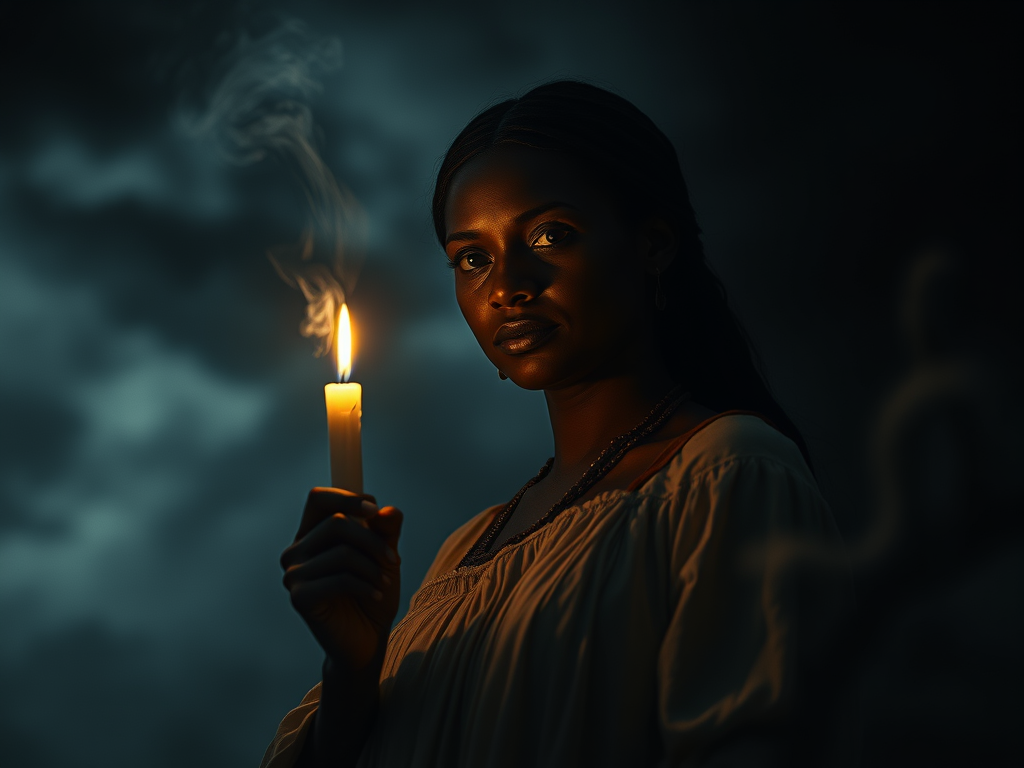
🕯️ Witch of the Week: Tituba
“The first to be accused. The first to confess. And the first woman they tried to silence.”
🩸 She was enslaved, beaten, and interrogated until she ‘confessed’ to dancing with the devil—because the town needed someone to blame.
In 1692, before the hysteria. Before the hangings. Before Salem became synonymous with the war on witches—there was Tituba.
A woman of color.
A woman without rights.
A woman whose forced confession ignited the deadliest witch hunt in American history.
She didn’t start the fire.
But they threw her in to feed the flames.

🔥 Who Was Tituba?
Tituba was an enslaved woman living in Salem Village in the household of Reverend Samuel Parris. Historians believe she was of South American or even possibly Caribbean origin—possibly Arawak or African. Her exact roots are debated with documentation labeling her as “Indian Woman, servant”. In several texts it’s clear that her raciel decent was unknown but what’s clear is this: Tituba was not white. She was not free. And she was not safe.
When Parris’s daughter and niece began experiencing strange fits, cries of witchcraft filled the air. A scapegoat was needed—and Tituba was the perfect target: foreign, dark-skinned, mysterious.
They accused her of sorcery.
Of speaking with the devil.
Of teaching the girls forbidden rites.
And after days of brutal beatings, she confessed.
But what she gave them wasn’t just a confession—it was the spark that lit a purge.

🕷️ A Story of Survival—and Strategy
Tituba didn’t confess because she was guilty. She confessed to survive. And she told them exactly what they wanted to hear: names, details, devilish plots. Her testimony—likely shaped by violence and fear—unleashed a wave of accusations that consumed the town.
Over 200 people were accused, and 20 were executed during the Salem Witch Trials. And it all began with Tituba’s broken voice echoing in the courtroom.
She spent over a year in jail, forgotten.
While the white women who accused her were eventually released, Tituba remained imprisoned until someone paid her jail fees. After that—she vanished from the record.
But her legacy?
Still burning.

🌒 The Witch They Needed Her to Be
Tituba was never allowed to be a person. She was turned into a myth, a warning, a villain, a footnote. Some retellings paint her as a magical priestess steeped in dark rites. Others erase her voice entirely. But what she really was—was a woman with no choices.
Forced into confession.
Forced into silence.
Forced into history’s margins.
Her story exposes how patriarchy and white supremacy walk hand in hand—how the fear of the “other” became a weapon to destroy women who stepped outside the lines… or were simply born outside them.
✨ Why Tituba Still Matters
Tituba represents every woman who has been othered, silenced, and blamed simply for existing outside the norm. She reminds us that witch trials were never really about magic.
They were about control.
About purity.
About erasing the power of those who didn’t fit.
Her story is a mirror—showing us how racism and misogyny fuel the fire of every system built to destroy the sacred feminine.
And in this moment, when women and people of color are still fighting to be heard, Tituba’s name rings like a warning bell in the wind.
🔮 What We Can Do
We speak her name.
We remember her story.
We honor her pain by refusing to let it be buried.
To be a witch today is to reclaim what was taken from women like Tituba.
Their freedom.
Their voice.
Their power.
When we light our candles, we light them for her.
When we cast protection, we cast it for every woman whose spirit was never laid to rest.
If you’d like to read more about Tituba here are some additional links to dive into:
https://wams.nyhistory.org/early-encounters/english-colonies/tituba/
https://salem.lib.virginia.edu/people/tituba.html
✊ Next Week’s Witch: Agnes Sampson
Burned for calling the storms, blamed for the weather, tortured into silence.
Next week, we’ll cross the sea to Scotland to honor a midwife and healer accused of raising winds to destroy a king.
Agnes was no sorceress—just a woman with knowledge the crown feared.
And like all witches, they called her dangerous because she dared to be wise.
Join the conversation!