
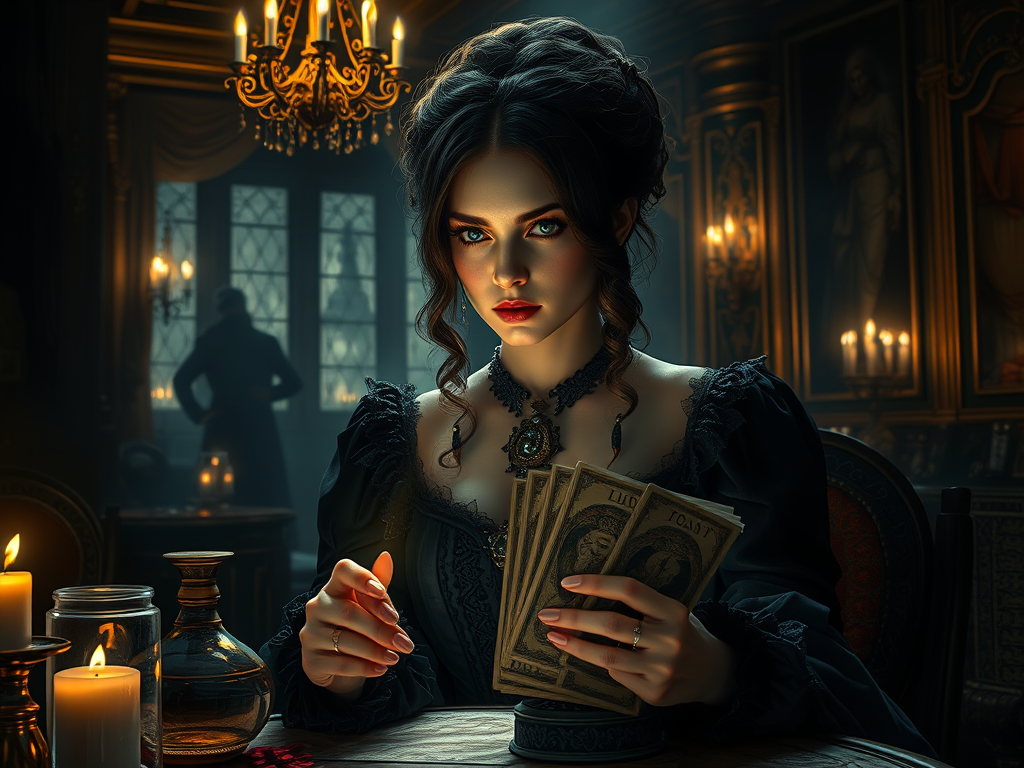
🥀 In a court dripping with perfume and hypocrisy, one woman sold salvation by the drop—and sealed her fate in fire as the La Voisin.
She was called a fortune-teller.
A poisoner.
A sorceress.
A heretic.
But to the noblewomen of Louis XIV’s glittering Versailles, she was something more: a lifeline.
Catherine Monvoisin—better known as La Voisin—was the queen of the underworld in 17th-century France. Her name was passed between silk-gloved hands in hushed whispers. She ran a secret network of midwives, potion-makers, and spiritualists that served the desperate and the powerful alike.
She dealt in the forbidden.
And for a while, it made her untouchable.
Until it didn’t.

🖤 Who Was La Voisin?
Born in Paris in 1640, Catherine Monvoisin rose from modest beginnings to become one of the most notorious figures in French occult history. A skilled midwife and palm reader, she gained popularity among women seeking more than society would ever allow them.
She read cards for aristocrats.
She performed abortions for desperate girls.
She brewed poisons and sold them in perfume bottles.
She was everything they said a woman shouldn’t be: powerful, self-sufficient, and in control of life and death.
Her house became the center of an underground empire: one part salon, one part black-market apothecary, one part spiritual sanctuary. And her clients? They wore jewels, rode in carriages, and slept in the king’s bed.
🕯️ The Affair of the Poisons
La Voisin’s downfall came not from her craft—but from who she helped. In the late 1670s, French authorities uncovered a tangled web of poisonings, black masses, and occult rituals among the elite. It became known as the Affair of the Poisons—a scandal so large it threatened the crown.
Among those implicated?
Madame de Montespan, the king’s mistress—and one of La Voisin’s best clients.
The rumors were apocalyptic:
• Masses performed over infant corpses.
• Love spells laced with blood.
• Poisons slipped into royal wine goblets.
The monarchy panicked. And when the king needed someone to burn to prove control, all eyes turned to the woman who had served them all.
La Voisin was arrested in 1679.
She was tortured and interrogated but refused to confess to everything they hoped to hear.
She was burned alive in public in 1680.
They couldn’t silence the aristocracy.
So they silenced her instead.

⚖️ Power, Secrets, and Survival
La Voisin wasn’t just a poisoner. She was a mirror—reflecting how desperate women became when cornered by the expectations of beauty, obedience, and silence. She offered choices where none existed. Escape in a bottle. Control in a charm. Safety in a secret.
She profited, yes.
But so did the society that made her necessary.
Her story is not just scandal—it is systemic.
She thrived because the world forced women to hide their needs in the shadows.
And then punished her for making those shadows habitable.
🌒 Why She Still Haunts Us
La Voisin’s name echoes any time women are punished for power, secrecy, or ambition. She represents every woman who had to survive by bending rules, cutting corners, or playing the game from the underside of the board.
They called her evil for doing what kings and priests did daily.
They burned her not for her sins—but for revealing everyone else’s.
In today’s world, she is a warning and a lesson.
That women will always find ways to survive.
That magic thrives in the margins.
And that truth, like poison, always rises to the surface.
Want to learn more?
https://www.syfy.com/syfy-wire/la-voisin-frances-murderous-fortune-teller

✊ Next Week’s Witch: Bridget Bishop
Outspoken. Fiery. Unapologetically herself.
Bridget was the first to hang in the Salem Witch Trials—accused not for witchcraft, but for refusing to shrink.
Next week, we’ll meet the woman who wore red, ran a tavern, and died for being too loud in a town that demanded silence.
Join the conversation!